Universalis

Gregorian Chant in October

+J.M.J+

Mass with Gregorian Chant

St Luke, Apostle, Evangelist
18 October, Wednesday
St Teresa's Church
8 pm.

Liturgy of the Hours

Vespers and Compline
22 October, Sunday
Adoration Chapel @ Church of Sts Peter and Paul
8 pm.

Translations are provided for all events.

Pope's remarks on Islam

Don't really have a proper commentary on this, but it seems that the recent incident of Pope Benedict's remarks on Islam is a positive demonstration of how we should handle matters that arise now and then in the public sphere. Bro. Micheal Broughton gave a very lucid and exemplary interview to the CatholicNews, which was reprinted by the TODAY newspaper. The CatholicNews should also be commended for coming out very quickly with a full spread of articles relating to the matter, the interview of course, as well as the Pope's full speech. Best of all, the archibishop issued a public statement, read at all churches, stating publicly our sincerity and apology. In my view, this whole affair was dealt with promptly, appropriately, gracefully, professionally. Well done. Let's pray that future affairs may be handled as such.

In fact, the pope's words seem to reflect a growing need for us to engage the public sphere, i.e. the rest of the word. His invitation to Muslim leaders, but more so his very initial words show that he is not afraid to speak out and take a stand on issues. Thus, there is a need for us to not shy away from the media but to learn how to use it effectively to engage others.

The pope's remarks are controversial, but thought-provoking. Fundamentally, it is a call to reason, or rather, a call to connect our faith and reason. Indeed, it is my belief that a lot of the worlds ills are caused by today's faithful disregarding reason, and today's thinkers disregarding faith. This is a rather deep point that maybe some of us can reflect upon. Have you thought and understood enough about your faith and the world?

This Blog is in Desperate Need of Spiritual Direction!

This blog is in desperate need of spiritual direction.

Please pray for us.

(and leave your comments if you have any)

Some links to ponder:
http://catholicwriter.wordpress.com/
http://theprompt.faithweb.com/
http://www.catholic.org.sg/
http://nuscssalumni.wordpress.com/

Gregorian Chant in September

+J.M.J+

21 September 2006


Feast of St Matthew
Mass with Gregorian Chant

8 pm
Church of St Teresa

---------------------------------------------------
24 September 2006

25th Sunday in Ordinary Time
Vespers and Compline

8 pm
Adoration Room
Church of Sts Peter and Paul

Translations are provided for all events.

Should the Catholic Church employ more professional laypersons?

One of the issues brought up in a previous post was that the Catholic Church should attract more professionals by offering them a higher pay. I would like to address this issue, as suggested by Chris, by bringing it up in a separate post.

FIRSTLY, the Catholic Church does employ a good number of people already, some with years (or decades) of experience in their field, often a very specific field, such as in pastoral care. Many of the people employed in the Catholic Church have a job scope that is specific towards the Catholic Church's needs, and there are very few people who meet those qualifications, regardless of their job experience in the secular world.

For example, if the diocese is looking for a highly qualified catechist, it would not offer an attractive pay even if its applicants are former teachers and lecturers of many years of experience, simply because while their experience in the secular world is of some use, they lack the specificity required in that particular job.

It is more than a mere job switch, it is closer to a career switch, since the aim, regardless of the job, tends to be quite different. As such, why should the Church pay a professional an attractive pay, if his profession is not exactly what the Church is looking for? Using the example of catechist, only one who has been trained in the specific field of catechism deserves such a pay.

SECONDLY, I certainly do believe that the majority of Church employees are already receiving a reasonable pay. If not, how would they be able to survive this long in such a job? Furthermore, how many Church employees have left their job solely because they are not being paid enough? None that I know of. Can anyone give a figure?

In the secular world, it would seem that many people never seem satisfied with their pay. People often leave their job for another because of a higher pay.

Some questions raised on this issue are:

- Is working in the Church just another job?
- How much does one consider a reasonable pay?
- Could one do with a lower pay by cutting down on unnecessary forms of expenditure, for example?

If insufficient pay really is the issue that makes working in the Church unattractive to some people, then I would say the reason for wanting to work in the Church is somewhat questionable. After all, what Church employees are paid is already reasonable, as shown in their length of employment. What may be a reasonable pay to some may be too low for others, but this is a subjective matter. Church employees have and still show that the Church does provide for them reasonably well.

THIRDLY and perhaps most importantly, a professional layperson is more valuable to the Church by being a Christian where he is in the professional world, than by being working in the Church. The laity is the front line of the Church in the world. If he is indeed a professional and good at what he does, then he will definitely do more good out there than working in the Church.

In an ideal situation, positions within the Catholic Church should be filled up by religious and priests. These minister to the laity, who in turn carry out the work of evangelisation. But we are not in an ideal situation, and we have far too few religious and priests, hence the need to hire laity to fill up roles that should rightfully be filled by the religious and priests.

The professionals, by virtue of their capabilities, belong in the secular world where they do the Church the most good there. This is, after all, the mission of the laity.

IN SUMMARY, the points are:

1. Lack of specificity in profession does not justify an attractive pay.

2. Using a higher pay to attract better workers raises the question of motive of working in the Church.

3. The mission of the laity is to be a Christian in the world. Professionals, by virtue of their capability, do the most good for the Church in the secular world.

What are your thoughts on this?

Singapore - The Malay Archipelago - Alfred Russell Wallace

I was reading this chapter on Singapore written by Lord Alfred Russell Wallace (Yes, the compatriot of Charles Darwin) who was in Singapore around 1854, and there was a quaint little entry about St. Joseph's Church! It would be lovely to get my hands on the recently published book about the history of the church in Singapore. Does anyone know the title and where to get it? Anway, click on the link above to read the whole of Wallace's chapter.

In the interior of the island the Chinese cut down forest trees in the jungle, and saw them up into planks; they cultivate vegetables, which they bring to market; and they grow pepper and gambir, which form important articles of export. The French Jesuits have established missions among these inland Chinese, which seem very successful. I lived for several weeks at a time with the missionary at Bukit-tima, about the centre of the island, where a pretty church has been built and there are about 300 converts. While there, I met a missionary who had just arrived from Tonquin, where he had been living for many years. The Jesuits still do their work thoroughly as of old. In Cochin China, Tonquin, and China, where all Christian teachers are obliged to live in secret, and are liable to persecution, expulsion, and sometimes death, every province—even those farthest in the interior—has a permanent Jesuit mission establishment constantly kept up by fresh aspirants, who are taught the languages of the countries they are going to at Penang or Singapore. In China there are said to be near a million converts; in Tonquin and Cochin China, more than half a million. One secret of the success of these missions is the rigid economy practised in the expenditure of the funds. A missionary is allowed about £30. a year, on which he lives in whatever country he may be. This renders it possible to support a large number of missionaries with very limited means; and the natives, seeing their teachers living in poverty and with none of the luxuries of life, are convinced that they are sincere in what they teach, and have really given up home and friends and ease and safety, for the good of others. No wonder they make converts, for it must be a great blessing to the poor people among whom they labour to have a man among them to whom they can go in any trouble or distress, who will comfort and advise them, who visits them in sickness, who relieves them in want, and who they see living from day-today in danger of persecution and death—entirely for their sakes.

My friend at Bukit-tima was truly a father to his flock. He preached to them in Chinese every Sunday, and had evenings for discussion and conversation on religion during the week. He had a school to teach their children. His house was open to them day and night. If a man came to him and said, “I have no rice for my family to eat today,” he would give him half of what he had in the house, however little that might be. If another said, “I have no money to pay my debt,” he would give him half the contents of his purse, were it his last dollar. So, when he was himself in want, he would send to some of the wealthiest among his flock, and say, “I have no rice in the house,” or “I have given away my money, and am in want of such and such articles.” The result was that his flock trusted and loved him, for they felt sure that he was their true friend, and had no ulterior designs in living among them.

The island of Singapore consists of a multitude of small hills, three or four hundred feet high, the summits of many of which are still covered with virgin forest. The mission-house at Bukit-tima was surrounded by several of these wood-topped hills, which were much frequented by woodcutters and sawyers, and offered me an excellent collecting ground for insects. Here and there, too, were tiger pits, carefully covered over with sticks and leaves, and so well concealed, that in several cases I had a narrow escape from falling into them. They are shaped like an iron furnace, wider at the bottom than the top, and are perhaps fifteen or twenty feet deep so that it would be almost impossible for a person unassisted to get out of one. Formerly a sharp stake was stuck erect in the bottom; but after an unfortunate traveller had been killed by falling on one, its use was forbidden. There are always a few tigers roaming about Singapore, and they kill on an average a Chinaman every day, principally those who work in the gambir plantations, which are always made in newly-cleared jungle. We heard a tiger roar once or twice in the evening, and it was rather nervous work hunting for insects among the fallen trunks and old sawpits when one of these savage animals might be lurking close by, awaiting an opportunity to spring upon us.

1 Corinthians 9

In an earlier post, Mark mentioned this passage, so I thought I'd just put it up as a reflection piece...:

1 Corinthians 9

The Rights of an Apostle
1Am I not free? Am I not an apostle? Have I not seen Jesus our Lord? Are you not the result of my work in the Lord? 2Even though I may not be an apostle to others, surely I am to you! For you are the seal of my apostleship in the Lord.

3This is my defense to those who sit in judgment on me. 4Don't we have the right to food and drink? 5Don't we have the right to take a believing wife along with us, as do the other apostles and the Lord's brothers and Cephas[ a]? 6Or is it only I and Barnabas who must work for a living?

7Who serves as a soldier at his own expense? Who plants a vineyard and does not eat of its grapes? Who tends a flock and does not drink of the milk? 8Do I say this merely from a human point of view? Doesn't the Law say the same thing? 9For it is written in the Law of Moses: "Do not muzzle an ox while it is treading out the grain." [b] Is it about oxen that God is concerned? 10Surely he says this for us, doesn't he? Yes, this was written for us, because when the plowman plows and the thresher threshes, they ought to do so in the hope of sharing in the harvest. 11If we have sown spiritual seed among you, is it too much if we reap a material harvest from you? 12If others have this right of support from you, shouldn't we have it all the more?

But we did not use this right. On the contrary, we put up with anything rather than hinder the gospel of Christ. 13Don't you know that those who work in the temple get their food from the temple, and those who serve at the altar share in what is offered on the altar? 14In the same way, the Lord has commanded that those who preach the gospel should receive their living from the gospel.

15But I have not used any of these rights. And I am not writing this in the hope that you will do such things for me. I would rather die than have anyone deprive me of this boast. 16Yet when I preach the gospel, I cannot boast, for I am compelled to preach. Woe to me if I do not preach the gospel! 17If I preach voluntarily, I have a reward; if not voluntarily, I am simply discharging the trust committed to me. 18What then is my reward? Just this: that in preaching the gospel I may offer it free of charge, and so not make use of my rights in preaching it.

19Though I am free and belong to no man, I make myself a slave to everyone, to win as many as possible. 20To the Jews I became like a Jew, to win the Jews. To those under the law I became like one under the law (though I myself am not under the law), so as to win those under the law. 21To those not having the law I became like one not having the law (though I am not free from God's law but am under Christ's law), so as to win those not having the law. 22To the weak I became weak, to win the weak. I have become all things to all men so that by all possible means I might save some. 23I do all this for the sake of the gospel, that I may share in its blessings.

24Do you not know that in a race all the runners run, but only one gets the prize? Run in such a way as to get the prize.

25Everyone who competes in the games goes into strict training. They do it to get a crown that will not last; but we do it to get a crown that will last forever. 26Therefore I do not run like a man running aimlessly; I do not fight like a man beating the air. 27No, I beat my body and make it my slave so that after I have preached to others, I myself will not be disqualified for the prize.

Church sued over 'exorcism'


Church sued over 'exorcism'

Woman claims damages for trauma of alleged exorcism by two priests and helpers at Novena Church

Wednesday • August 30, 2006

— Channel NewsAsia

NOVENA Church, two priests and seven helpers are being sued for an alleged act of exorcism, in an incident believed to have taken place two years ago.

Ms Amutha Valli Krishnan, 50, an athlete in the 1980s, claimed that attempts to exorcise her later led to chronic post-traumatic stress disorder and depression. A writ of summons was served last Thursday.

In the writ, Ms Amutha Valli claimed that on August 10, 2004, she went to Novena Church to pray with her son, daughter and a close friend. She fainted while she was there.

She is alleging that two priests from the church, Father Simon Tan and Father Jacob Ong, claimed she had been possessed by a spirit, and then performed an act of exorcism, helped by seven others.

The ritual is said to have lasted two-and-a-half hours, during which time Ms Amutha Valli claimed she had resisted furiously. She claimed she was strangled, pinned down and verbally abused.

When contacted, Father Tan claimed Ms Amutha Valli did not faint in church. In fact, he said, she had walked in asking for help, saying she was possessed.

Father Tan also denied any act of exorcism. He said he, Father Ong and seven helpers only said prayers over her.

Ms Amutha Valli's claims against the defendants include trespass, assault, false imprisonment and negligence. She is also asking for damages for loss of income and injuries.

Mr Suppiah Jeyabal, her husband, said: "Before, she was an athlete and ... a very tough person, you know, who (liked) to exercise; she must run and exercise. She also used to coach children — a very tough and active person.

"But now, she's more like a vegetable."

A medical report by a Changi General Hospital psychiatrist states that Ms Amutha Valli's symptoms — which are persistent, severe and extremely disabling —- are a direct result of the traumatic incident she experienced at the church.

According to the report, this has affected her ability to cope with self-care, demands at home and relationships with family members. The doctor added that she would require long-term treatment and follow-up, and is unlikely to fully recover.

Ms Amutha Valli's lawyer said it is still too early to comment, but he believed this is the first such case in Singapore.

The lawyer for the defendants says his clients deny liability and will file their defence by Sept 16. The civil suit is estimated to cost at least $1 million.


Just incidentally, last Sunday's papers quoted a Novena priest describing an exorcism in which a very shy girl suddenly having immense strength. Are priests allowed to share such things?

Back to this case, the Church takes exorcisms extremely seriously, so I doubt that the priests would have performed an exorcism so wantonly. Also, I don't see any reason that the priests should lie. However, there is enough evidence to say that something happened, and that this lady suffered for it. It'll be interesting to see how this plays out. Did the priests do something wrongly? Is this women a pathelogical liar? Will people be afraid to go the Novena Church now?

With the Catholic Church being in the public limelight yet again, I do hope that we do nothing to affect our public image negatively, and I do hope that we actually put a positive light to this sorry incident. It is times like this where I wonder if the church should have a full time publicist. I hope that the evidence reassures the public that we do not abuse and exorcise people like so, and I also hope that the women receives fair recourse and all the help that she needs. Even if the church wins this case, which it should I think, it must be careful not to come across as having condemned this women as a madwomen and putting her down just as a liar.

In my view, the church has not given a good account of itself in the public eye in recent times. There was the vague response to the tsunami. There was silence on the Nguyen (btw, there is another drug trafficker due for execution) and casino issues when other churches were more clear on their stances. The Da Vinci Code has surely damaged some opinion, and the Joaquim Kang case got a lot of publicity, but scarcely a squeak from the church. Through it all, I do feel that a normal person will just be that slight bit less inclined to find out about the church and know Christ through all the negative perceptions in the public eye. To do justice to our faith, we need to project a good impression of our faith.

Why do our young men choose to go overseas to become priests?

Nelsoh Quah, in the Sept 3rd issue of the Catholic News asks:

... Some pertinent questions which have been recurring in the minds of many Catholics are: Why do our young men today choose to make personal sacrifices to go overseas and become religious society priests? Why are they not interested in going to the local seminary and becoming diocesan priests?

Perhaps, it is time for the local chuch authority and some relevant organization to do some soul-searching to search for the right answers. Catholics should pray that the Lord of the Harvest will reveal the answers to them.
Of course, a very easy answer would be that God is calling them overseas and not here, and maybe because they feel blessed to live in Singapore and want to serve elsewhere. However, Mr Quah is not really hiding the fact that he knows what the real reason is. It is that the archodiocese is not being professional enough and thus not attracting the right people...

Please do not respond if you don't know the meaning of constructive criticism.

Websites of the Catholic Church

The Holy See


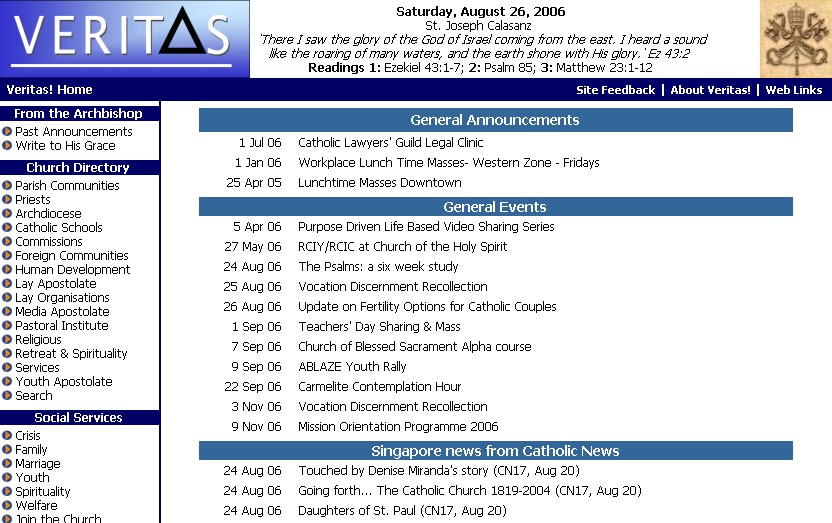
Veritas! The Official Website of the Archdiocese of Singapore


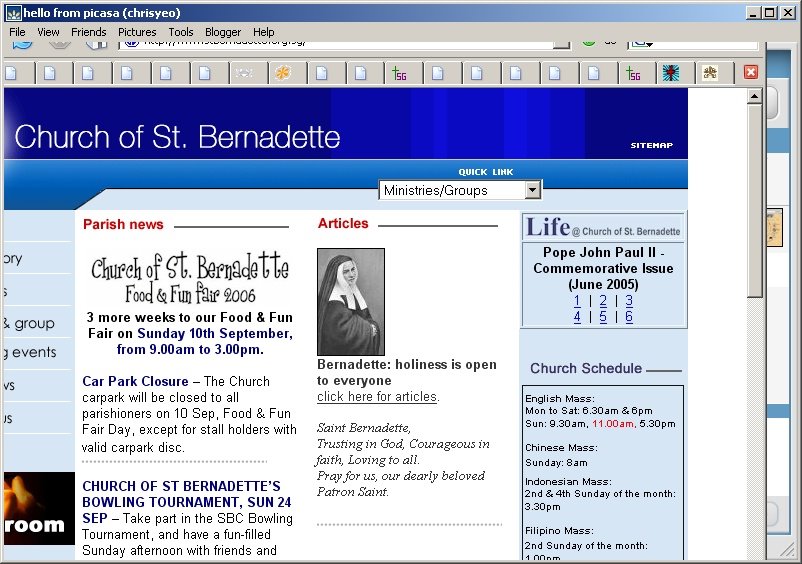
St. Bernadette


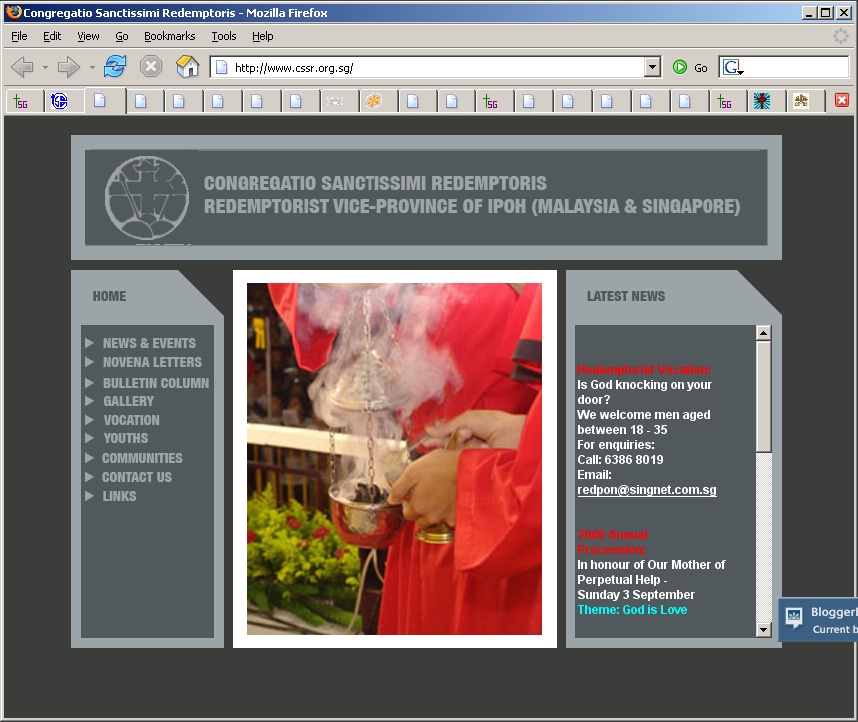
The Redemptorists/Novena Church


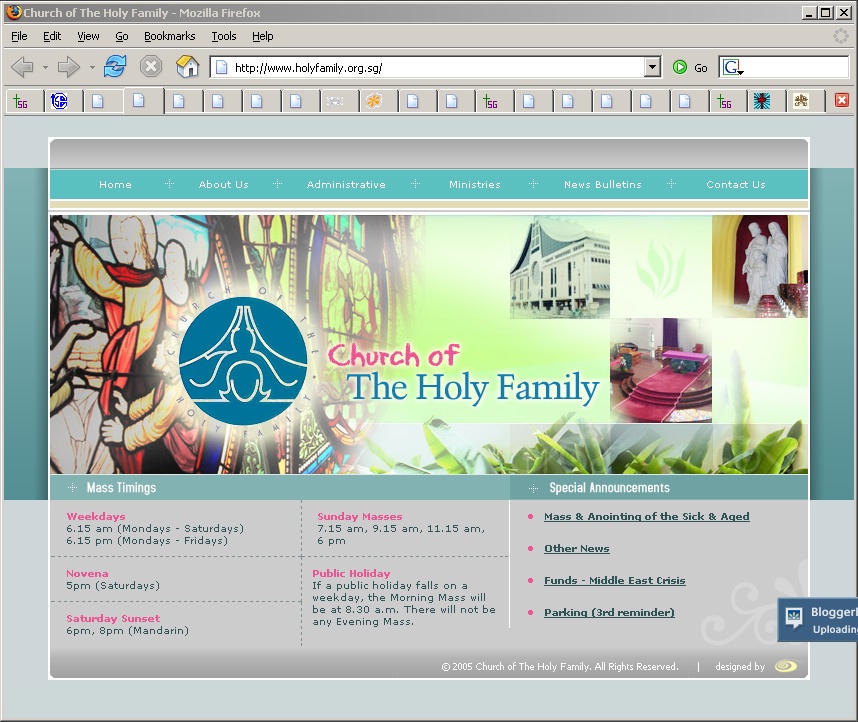
Church of Holy Family


Church of Holy Trinity


Our Lady of Perpetual Succour


St. Francis of Assisi


St. Ignatius


St Mary of the Angels


Church of the Holy Cross


Christ the King


Our Lady Star of the Sea


St. Anthony


Holy Spirt


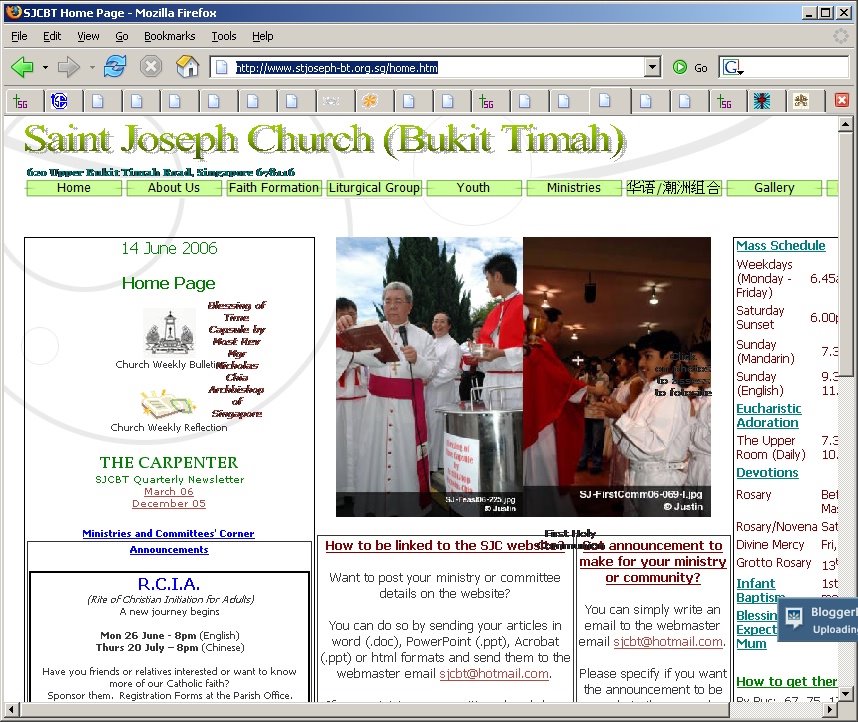
St. Joseph's Bukit Timah


Risen Christ


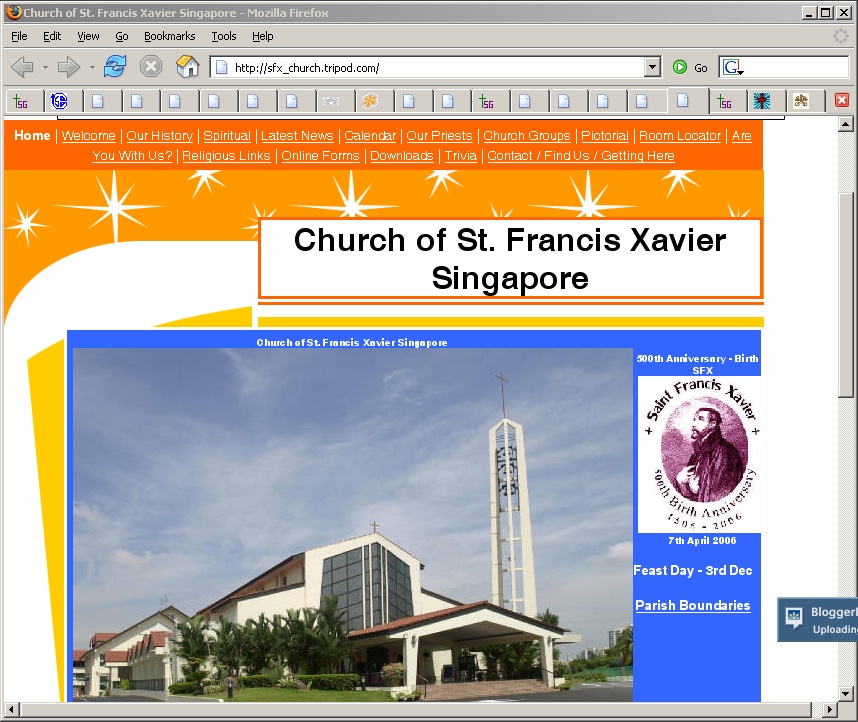
St. Francis Xavier


Immaculate Heart of Mary


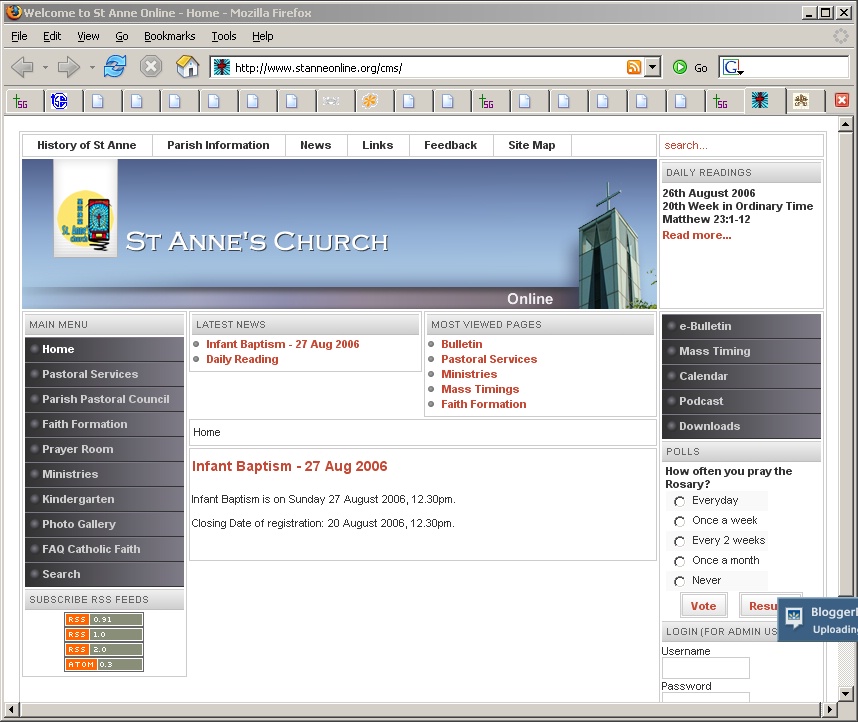
St. Anne's Church

The Catholic View on The Death Penalty (?)

Is someone able and willing to enlighten me on what exactly is the the Catholic Church's stand on the death penalty, specifically with relation to Singapore? What should an ordinary Catholic here understand of the Singaporean laws on the death penalty?

As I currently understand it, we are supposed to be in opposition to the death penalty, chiefly because life is God given and should not be man-taken. Yet, as some Catholic lawyers here have pointed out, the Church is not opposed to the death penalty. This is presumably because some evil men (PC:'persons'; e.g. serial murderers) deserve the death penalty. So, what is the ordinary Catholic to think of it? Would a fair statement be: "let's just leave it to the lawyers and theologians to think about; It's none of our business"?

Sociologically and politically, it seems that the local church is not willing to act on this issue because there are more important social issues to cover (such as poverty and raising funds for a new church). It seems like more good can be achieved by avoiding certain topics that are deemed too 'sensitive' or 'complex'.

Please feel free to add to or correct what I have expressed here, which is a purely personal and unresearched opinion.